Process, principles & ethics
Mediation models, neutral roles, informed participation, confidentiality, and the boundaries of a mediator's authority.

A complete, online 40-hour mediation curriculum designed to complement law school ADR courses, clinics, experiential programs, and professional-skills instruction.
Give students a structured way to learn the theory, practice the conversations, and reflect on the decisions that define effective mediation—with licensing options designed for faculty and institutions.
Students need more than familiarity with mediation theory. They need opportunities to attempt the work: listen, ask better questions, manage difficult exchanges, recognize interests, and support constructive negotiation.
VirNet combines concise video instruction, readings and outlines, knowledge checks, reflective assignments, and AI-assisted role-play simulations. The modules are sequenced to help students connect the legal and ethical framework to practical mediator decisions.
Explore learning outcomesBuild a foundation with lectures, outlines, models, and ethical frameworks.
Take the mediator's role in realistic AI-assisted conversations.
Evaluate choices, language, process management, and next steps.
Apply lessons to the next scenario; individualized instructor feedback is available under selected licensing arrangements.
Ten progressive course modules develop the essential habits of mediation. These five themes summarize the learning progression; they are not separate courses or credentials.
Mediation models, neutral roles, informed participation, confidentiality, and the boundaries of a mediator's authority.
Open questions, reframing, emotional awareness, interest-based bargaining, and clear communication under pressure.
Managing escalation, participant needs, cultural context, difficult conversations, and process safeguards.
Working from opening statements through issue framing, option development, agreement drafting, and closure.
Virtual dispute resolution, reflective practice, ongoing learning, and the transition from classroom exercises to professional settings.
Use the curriculum as a complete training pathway or a structured supplement to faculty-led teaching. Its modular format makes it adaptable to different academic calendars and instructional goals.
Prepare students to recognize mediator responsibilities and practice constructive engagement before they encounter live disputes in appropriate supervised settings.
Pair doctrinal instruction with applied scenarios, downloadable materials, and progressive skill development.
Introduce listening, reframing, professional judgment, and structured problem-solving early in legal education.
Provide on-demand access for students balancing coursework, clinics, employment, or geographic constraints; explore bar-prep supplementation where relevant.
Adopt the full sequence, incorporate selected modules into an existing class, or give students access alongside clinics and skills instruction. VirNet provides the foundational course content; your faculty determine how it fits course objectives, supervision, grading, and academic-credit requirements.
Ask for a faculty access code and sample course outline.
Request faculty access and a sample syllabus or course outline.
Identify your courses, cohort size, instructional goals, and academic calendar.
Select access and instructor-support terms that suit the program.
Coordinate student access and integrate the curriculum into faculty-led learning.
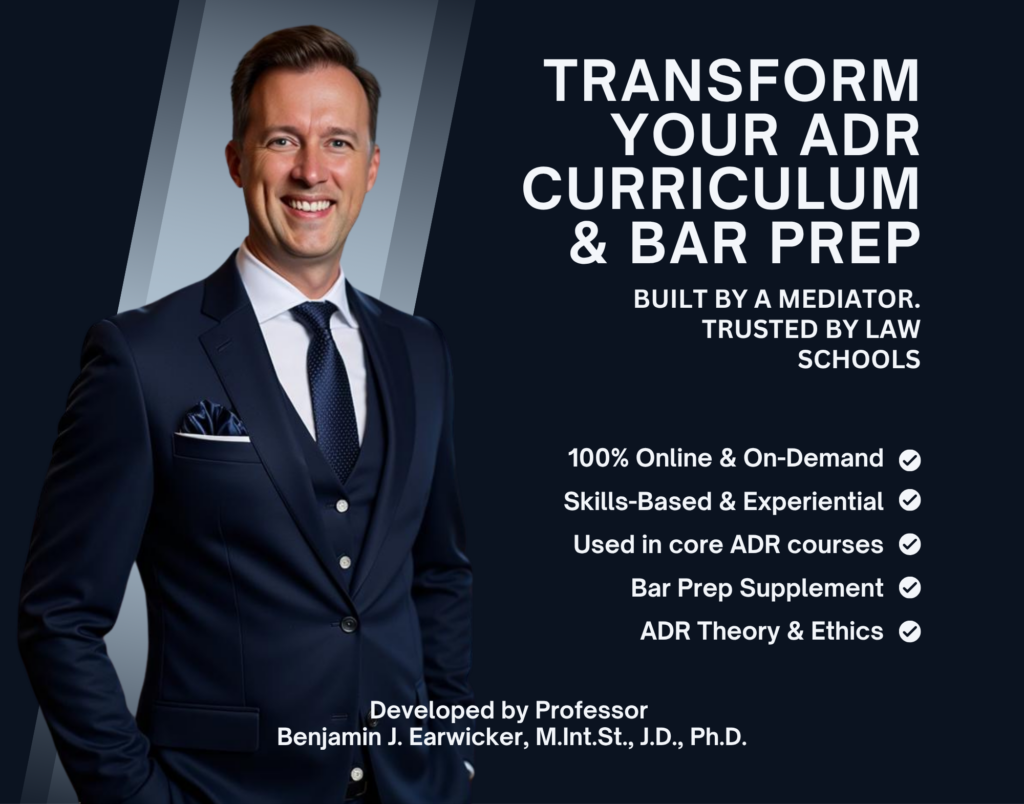
Dr. Benjamin J. Earwicker, J.D., Ph.D., brings together legal education, mediation practice, civil rights administration, and more than two decades of university and professional teaching experience.
He has taught Negotiations and Alternative Dispute Resolution at the University of Idaho College of Law and designed VirNet's online foundational mediation curriculum around clear instruction, realistic practice, and reflective learning.
Every law school has its own instructional needs. These are common starting questions; we can discuss your program's specific requirements directly.
Potentially, yes. We can discuss the sequence and content that best support an existing ADR course or clinic, subject to the terms of the institutional license.
No. Self-directed access includes the curriculum and applied learning activities; individualized review and feedback must be included in the selected agreement.
The course is online and on demand. Faculty may set their own class milestones and deadlines, while institutional access windows are determined by the licensing agreement.
No. Academic credit, experiential classification, and court or state training recognition are determined by the relevant institution or authority. Completion of VirNet's course does not itself grant an external credential.
Yes. Email Ben to request a faculty preview, course outline, and an institutional licensing discussion. Include your institution and intended program if possible.
I'd be glad to share a faculty preview, discuss curriculum fit, and prepare institutional licensing options for your law school. Contact me directly—no general intake process required.
Helpful details to include: law school, course or clinic, anticipated student enrollment, preferred semester, and whether instructor feedback is desired.